
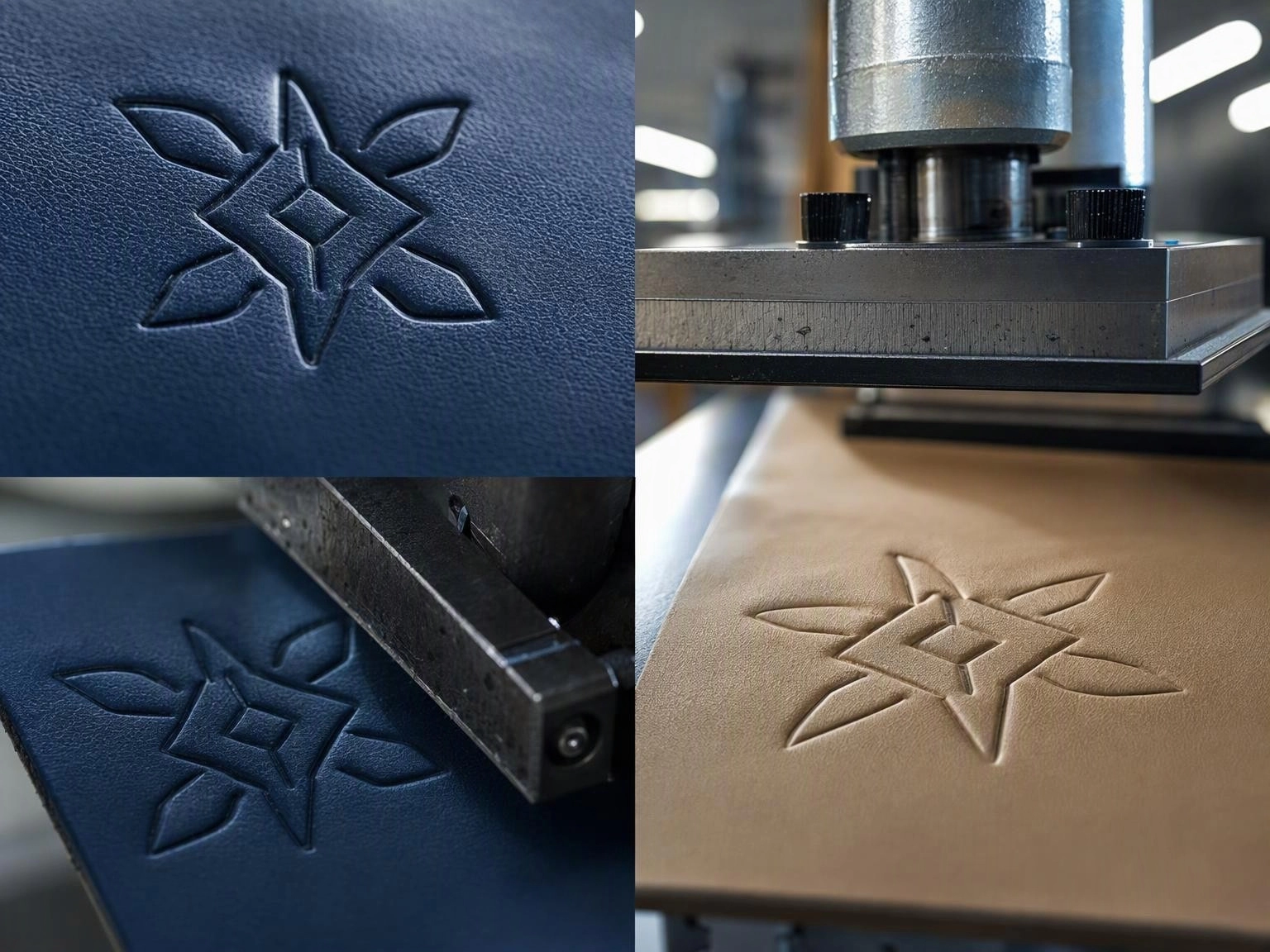
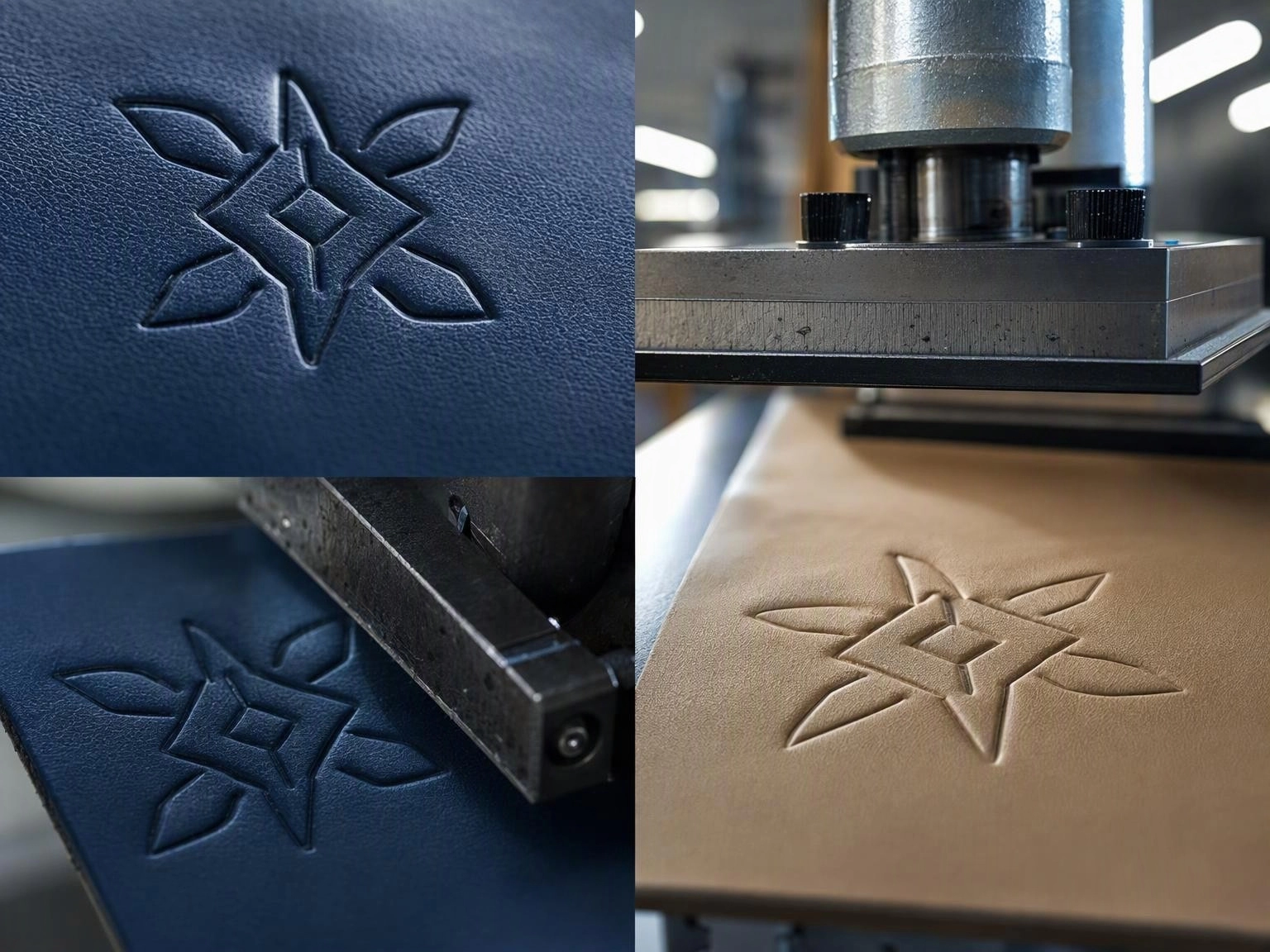
What makes a logo emboss clear
A logo emboss is judged on three qualities: edge definition, depth and uniformity. Edge definition is whether the outline of the mark reads as a crisp line rather than a soft one. Depth is how far the mark stands proud of or sinks into the surrounding surface. Uniformity is whether the mark looks the same across the whole surface and from item to item.
All three are decided by the same variables: the engraved die, the temperature of the material, the pressure applied and the cooling that follows. Understanding how they interact is what separates a mark that survives handling from one that flattens in a day.
The engraved die and its geometry
The die carries the geometry of the mark, and its engraving quality sets the ceiling for the result. Sharp edges on the die produce sharp edges on the surface. A die with rounded transitions produces a mark that reads as soft regardless of how the rest of the process is tuned.
Die material and surface treatment matter for wear. A die that erodes at the corners loses edge definition progressively, so marks produced early and late in a long run can differ. Tracking die condition and retiring dies before the loss becomes visible is part of holding a consistent mark.
Temperature pressure and dwell
The material must be soft enough to accept the mark without being so soft that the surrounding surface deforms. Temperature, pressure and dwell time work together, and as in grain embossing, the correct technique is to fix two variables and adjust one.
For a deep mark the natural instinct is to raise pressure, but pressure alone produces a shallow mark on a stiff surface. Raising temperature first, then applying moderate pressure, gives a deeper mark with a cleaner edge because the surface flows into the die rather than being crushed against it.
Cooling and the reason marks fade
Cooling is the step most often given insufficient attention. A mark is held by the material only once the coating has set. If the material is released while still warm, the surface recovers elastically and the depth is lost, which is why a mark that was clear immediately after embossing can look shallow by the time it is packed.
Controlling the release temperature, and allowing the mark to cool in contact with the die long enough, is what makes depth persistent. This is also why the same die and the same pressure can produce different depth on different lines: the cooling conditions differ.
Dimensional appearance and the surrounding surface
A logo rarely appears on a plain surface. Where it is applied to an already embossed surface, the two patterns compete, and the mark can be lost visually if the background grain has a similar scale and contrast. Placing the mark on a smoother zone, or increasing the mark depth relative to the background, restores visual separation.
A dimensional appearance around the mark, sometimes achieved by embossing a raised border or a recessed field, increases apparent depth without requiring a deeper die. This is often the better route because it adds depth to the eye while keeping the mark shallow enough to resist flattening during use.
Judging the result consistently
Logo clarity should be assessed under the same lighting the product will be viewed in, because raking light exaggerates or conceals depth markedly. Assessment should also include a short wear simulation, most usefully a rub test over the mark, since the real failure mode is depth loss under handling rather than a defect visible at the press. Retaining an approved reference sample, produced on the same line with the recorded parameters, is what allows a later dispute to be settled by measurement rather than by opinion.