
What the crocking test measures
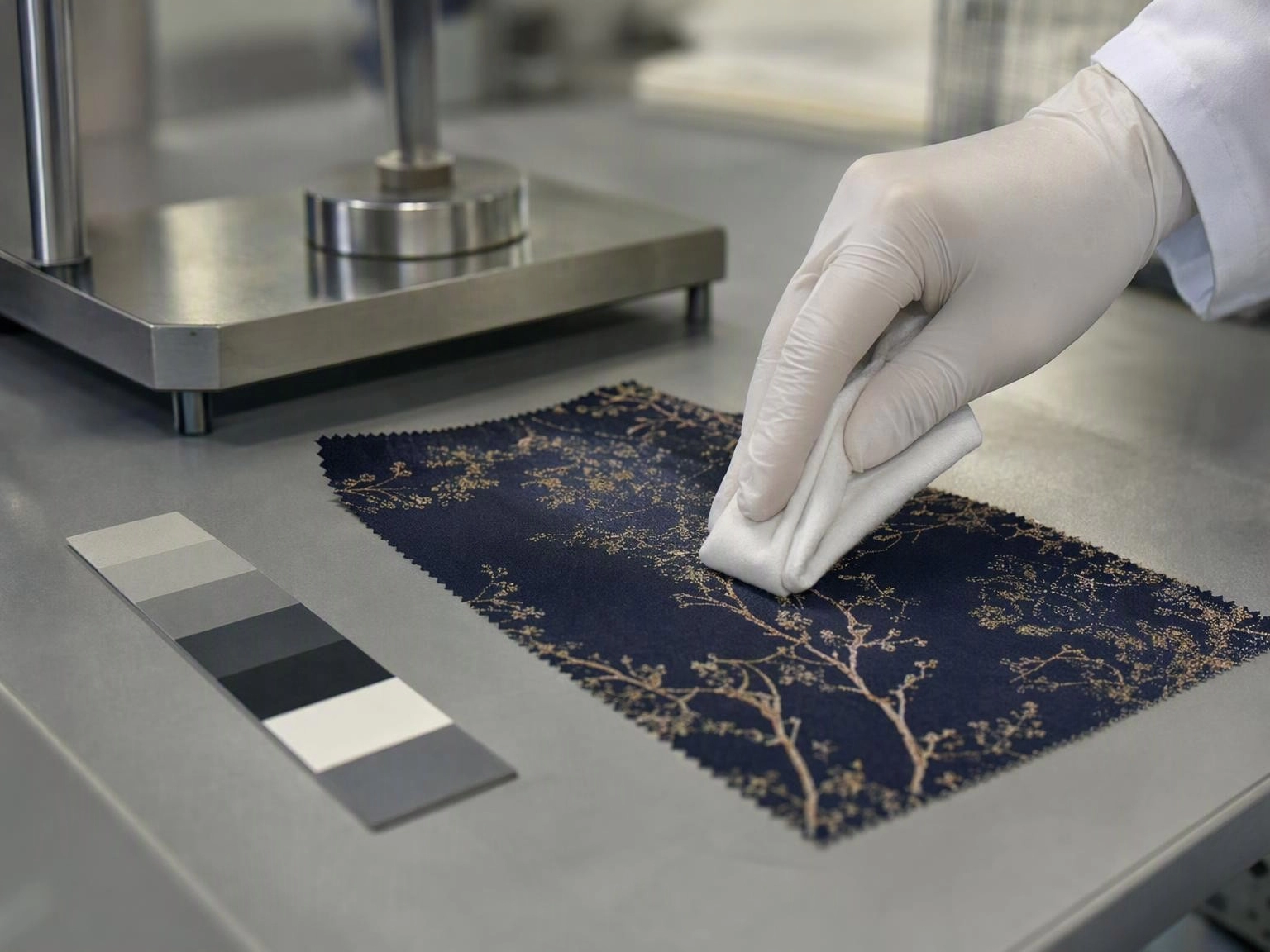
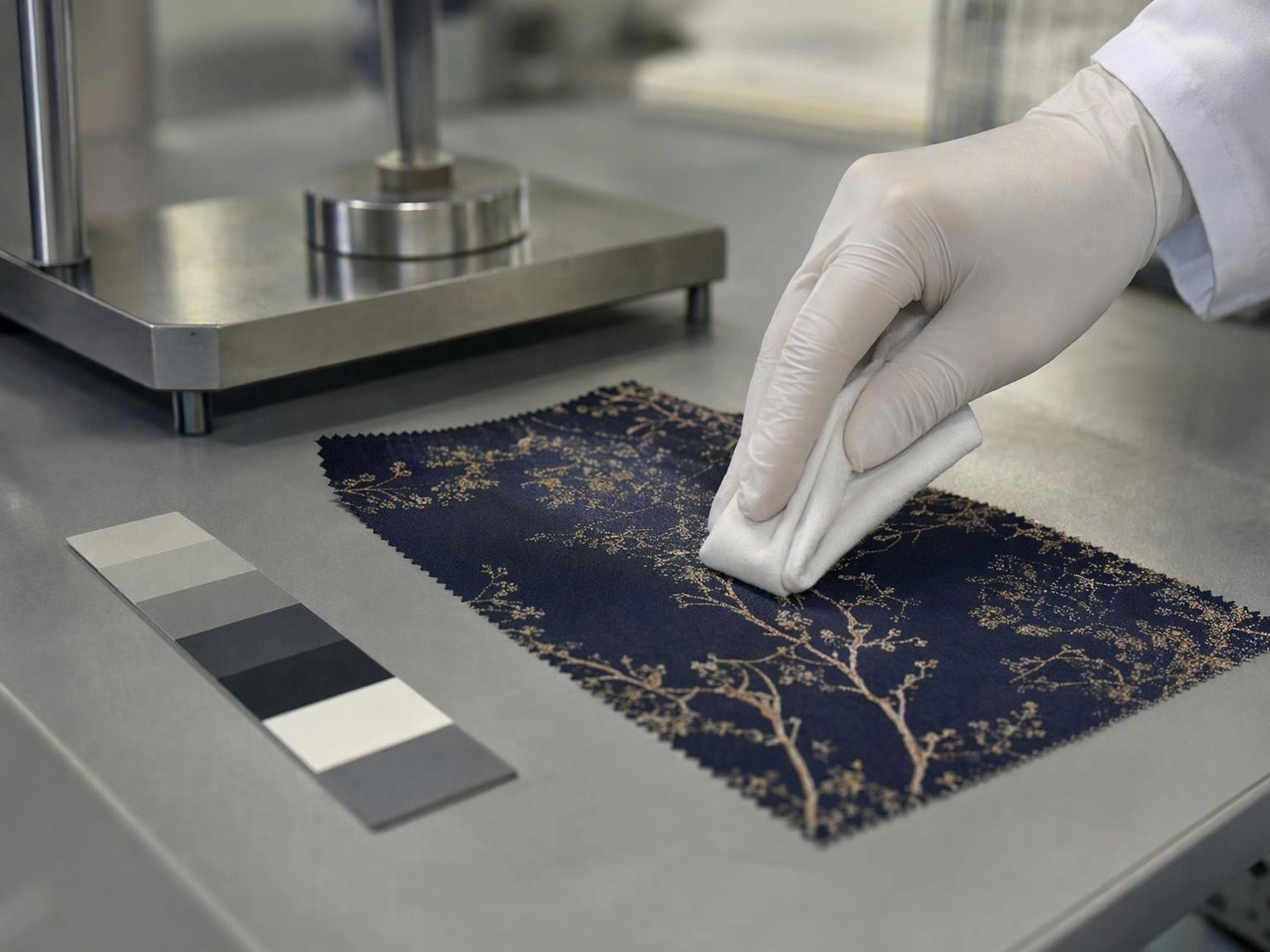
Colour fastness to rubbing, usually called crocking, measures how much colour transfers from a surface onto a white cloth under controlled pressure. It is a simple test with a deceptively simple question behind it: will this material mark the thing it touches. A printed or coated fabric can look perfect and still fail here, because the test works on the surface layer rather than the base colour.
How the test is run
A standard white crocking cloth is rubbed against the sample under a fixed load for a fixed number of strokes, with the cloth mounted on a moving finger. The cloth is then compared against a grey scale and assigned a grade, where 5 means no visible transfer and 1 means heavy transfer. The result is a pair of numbers: one from a dry rub, one from a wet rub.
Dry rub reflects mechanical transfer of pigment or topcoat under friction. Wet rub adds water or a specified liquid, which softens the binder and increases pigment mobility, so wet results are almost always lower than dry results for the same article.

Reading dry 4.5 and wet 3.5
A dry result of 4.5 sits between slight and negligible transfer, which is a strong result for a decorative surface: the cloth is barely stained after the rub. A wet result of 3.5 is a moderate transfer, meaning the cloth is visibly but lightly stained. This pair is a realistic and commercially useful specification for a printed coated fabric, and it is far better than quoting a single headline number.
The important point is that these two numbers must be reported together. A high wet result with a low dry result, or the reverse, points to different causes and cannot be judged from one figure.
The wet result is the one under pressure
Wet rub is where most decorative articles are at risk, because moisture plasticises the binder in the print or topcoat. Improving it usually means increasing cross linking in the surface layer, raising topcoat coverage so the pigment is fully encapsulated, or reducing pigment loading in favour of a topcoat that carries the colour. Each of these has a trade off in hand feel or cost, which is why wet rub targets should be set before the sample is approved rather than tested afterwards.
Common causes of misread results
Results are frequently reported in ways that cannot be compared. Testing a flat swatch and then applying the number to a deeply embossed surface is misleading, because the raised features of an embossed surface take the rub differently from a flat one. Not stating the load and the number of strokes makes the grade meaningless. Testing the back of the material gives a completely different result from testing the face, and both are legitimate if they are labelled.
Conditioning also matters. A sample tested straight from a humid environment will not match one tested from a dry store. For reliable comparison, fix the load, the stroke count, the face tested and the conditioning, and report all four alongside the grade.